Convert your Cumulative CGPA to Percentage instantly
Understanding your academic performance is crucial for career planning and educational progression. If you’re a student dealing with the 10-point grading system, you’ve likely wondered how to convert CGPA into percentage accurately. A Cumulative CGPA to Percentage Calculator makes this process simple by converting your overall CGPA into its percentage equivalent within seconds. This comprehensive guide will help you understand cumulative CGPA conversion, learn the commonly used formulas, and navigate university-specific requirements with confidence.
CGPA (Cumulative Grade Point Average) represents your overall academic performance across all semesters, while percentage provides a more familiar numerical representation that is widely accepted in India and internationally. Whether you’re applying for higher education, jobs, scholarships, or competitive exams, a Cumulative CGPA to Percentage Calculator helps you obtain accurate percentage results quickly and reliably.
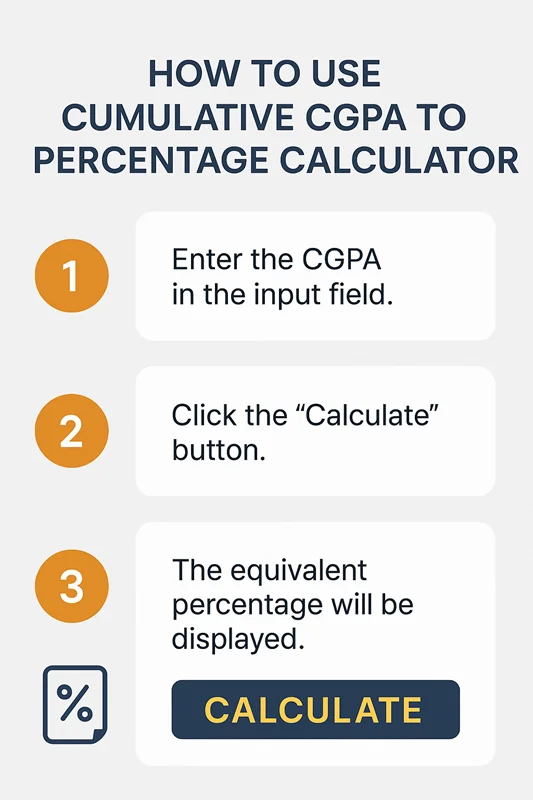
Simply use the Cumulative CGPA to Percentage Calculator by following these easy steps:
Enter your cumulative CGPA.
Select your university or board, if applicable.
Choose the appropriate conversion formula (standard or university-specific).
Click the calculate button.
View your percentage instantly.
Review the step-by-step calculation breakdown if available.
A Cumulative CGPA to Percentage Calculator eliminates manual calculations, minimizes errors, and saves valuable time when preparing academic documents or application forms.
Cumulative Grade Point Average (CGPA) is the average of all SGPA (Semester Grade Point Average) values earned throughout your academic program. It reflects your overall academic performance across all completed semesters.
A Cumulative CGPA to Percentage Calculator uses your final CGPA to determine the equivalent percentage according to accepted conversion methods.
CGPA = (Sum of all SGPA × Credits for each semester) ÷ Total Credits
Semester Grade Point Average (SGPA) measures your academic performance during a single semester. It is calculated using the weighted average of grade points earned in all subjects completed during that semester.
SGPA = (Sum of Credit Points) ÷ (Sum of Credits)
Where:
Credit Points = Grade Points × Credits for each subject
Although SGPA measures semester performance, a Cumulative CGPA to Percentage Calculator focuses on your overall CGPA because employers and universities usually require cumulative academic results.
| Aspect | CGPA | SGPA |
|---|---|---|
| Scope | All semesters combined | Single semester only |
| Calculation Period | Entire course duration | One semester |
| Usage | Final transcripts, job applications | Semester performance tracking |
| Weightage | Includes all completed semesters | Current semester only |
Understanding these differences helps students use a Cumulative CGPA to Percentage Calculator correctly and interpret their academic performance more effectively.
Converting your cumulative CGPA into percentage serves several important purposes. A Cumulative CGPA to Percentage Calculator makes this conversion quick, accurate, and convenient.
Many Indian companies and multinational organizations request percentage scores during recruitment. HR departments often set eligibility criteria based on percentages instead of CGPA. Using a Cumulative CGPA to Percentage Calculator ensures your application includes an accurate percentage.
Universities in India and abroad frequently require percentage equivalents for admissions. MBA, MS, M.Tech, and other postgraduate programs often specify minimum percentage requirements. A Cumulative CGPA to Percentage Calculator helps applicants determine whether they meet these eligibility criteria.
Civil services, banking, railway, defense, and other government recruitment processes commonly require percentage scores instead of CGPA. Converting your CGPA accurately helps avoid mistakes during the application process.
Many merit scholarships, financial aid programs, and educational grants evaluate applicants using percentage-based academic performance. A Cumulative CGPA to Percentage Calculator helps students convert their grades accurately before submitting scholarship applications.
Entrance examinations such as CAT, GATE, GRE, GMAT, and several university entrance tests often require candidates to enter their percentage during registration. By using a Cumulative CGPA to Percentage Calculator, students can confidently provide accurate academic information while completing online application forms.
Overall, a Cumulative CGPA to Percentage Calculator simplifies academic conversions, saves time, reduces calculation errors, and helps students prepare confidently for admissions, placements, scholarships, and future career opportunities.
| CGPA | Percentage | Grade | Performance Level |
|---|---|---|---|
| 10.0 | 95.0% | O (Outstanding) | Exceptional |
| 9.5 | 90.25% | A+ (Excellent) | Excellent |
| 9.0 | 85.5% | A+ (Excellent) | Excellent |
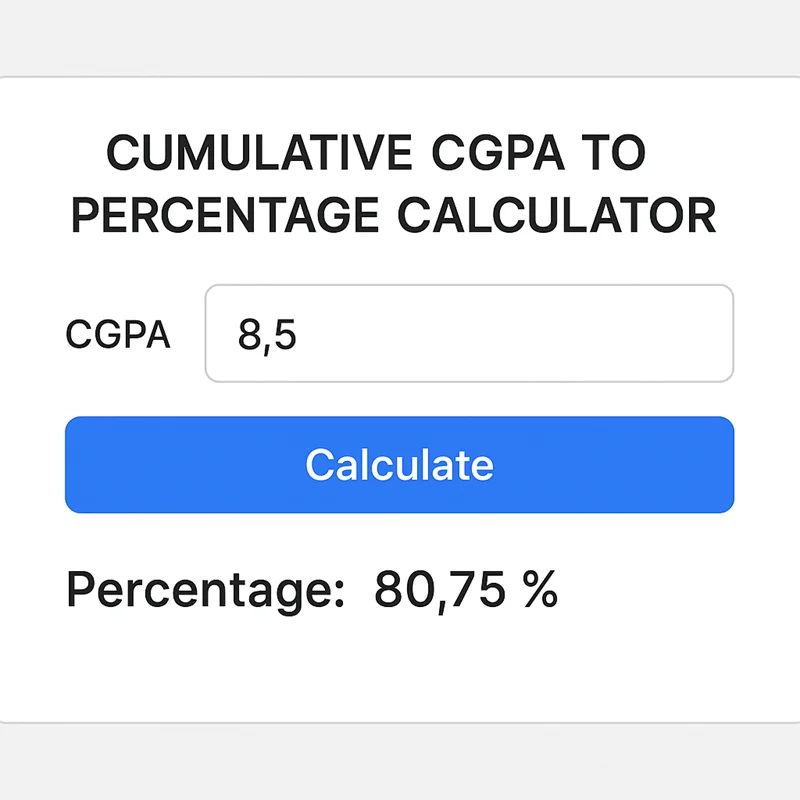
| 8.5 | 80.75% | A (Very Good) | Very Good |
| 8.0 | 76.0% | A (Very Good) | Very Good |
| 7.5 | 71.25% | B+ (Good) | Good |
| 7.0 | 66.5% | B+ (Good) | Good |
| 6.5 | 61.75% | B (Above Average) | Above Average |
| 6.0 | 57.0% | B (Above Average) | Above Average |
| 5.5 | 52.25% | C (Average) | Average |
| 5.0 | 47.5% | C (Average) | Average |
| 4.0 | 38.0% | D (Below Average) | Pass |
| CGPA | Percentage | CGPA | Percentage | CGPA | Percentage |
|---|---|---|---|---|---|
| 8.1 | 76.95% | 8.2 | 77.9% | 8.3 | 78.85% |
| 8.4 | 79.8% | 8.5 | 80.75% | 8.6 | 81.7% |
| 8.7 | 82.65% | 8.8 | 83.6% | 8.9 | 84.55% |
| 9.1 | 86.45% | 9.2 | 87.4% | 9.3 | 88.35% |
| 9.4 | 89.3% | 9.6 | 91.2% | 9.7 | 92.15% |
A Cumulative CGPA to Percentage Calculator is an essential tool for students who need to convert their overall CGPA into an accurate percentage quickly and efficiently. Whether you are applying for higher education, scholarships, internships, campus placements, competitive exams, or government jobs, using a Cumulative CGPA to Percentage Calculator helps you present your academic performance in a format that is widely accepted by universities and employers.
Instead of spending time on manual calculations, a Cumulative CGPA to Percentage Calculator delivers instant results while reducing the risk of errors. It also helps students understand how their cumulative CGPA translates into percentage according to commonly accepted conversion formulas. Regularly using a Cumulative CGPA to Percentage Calculator allows you to track your academic progress, verify your results before submitting applications, and make better academic and career decisions. By knowing your percentage equivalent, you can confidently complete application forms and ensure your academic records are accurate.
Ready to convert your cumulative CGPA into percentage within seconds?
Use our free Cumulative CGPA to Percentage Calculator to get fast, reliable, and accurate results using widely accepted conversion methods. The tool is simple to use and is designed to help students save time while avoiding manual calculation mistakes.
Visit: https://www.cgpa2percentage.com/
Our website provides a user-friendly Cumulative CGPA to Percentage Calculator along with a wide range of GPA, CGPA, SGPA, and percentage conversion tools for students from different universities and grading systems. Whether you are preparing for admissions, scholarships, placements, or professional opportunities, the Cumulative CGPA to Percentage Calculator can help you calculate your percentage confidently and accurately. Start using the calculator today to simplify your academic conversions, monitor your progress, and make informed decisions for your educational and career goals.

CGPA to Percentage is a free educational platform that helps students calculate CGPA, GPA, percentages, grades, credit hours, and other academic scores.
© 2026. All rights reserved.