📊 Grade Conversion Scale
A*
4.0
A
4.0
B
3.3
C
2.7
D
2.0
E
1.0
U
0.0
🧮 Enter Your A-Level Results
Your Calculated GPA
0.00
out of 4.0
Add subjects above to calculate your GPA
Track your academic workload accurately by calculating completed, enrolled, and remaining credit hours.
Convert your UK A-Level grades to US 4.0 GPA scale
💡 This calculator provides an estimated GPA conversion. Individual universities may use different conversion scales.
Converting your A-Level grades to GPA can feel overwhelming, especially when applying to universities abroad. This comprehensive guide will walk you through everything you need to know about A-Level to GPA conversion, providing you with the tools and knowledge to calculate your GPA accurately.
While we’ll explain the manual conversion process throughout this guide, using a reliable A Levels to GPA Converter is the fastest way to get accurate results. An A Levels to GPA Converter automatically converts your grades using standardized conversion tables and commonly accepted GPA formulas. Students applying to universities abroad often use an A Levels to GPA Converter to understand how their academic performance compares within GPA-based education systems.
Enter each of your A Level subjects and grades.
Include any AS Level results if applicable.
The A Levels to GPA Converter will calculate your cumulative GPA.
Most calculators provide results on both 4.0 and 5.0 GPA scales.
Review your converted GPA and compare it with university admission requirements.
Remember that different universities may have their own conversion methods, so always check with your target institutions for their specific requirements. Although an A Levels to GPA Converter provides a useful estimate, some universities may perform their own evaluation of academic records. Using an A Levels to GPA Converter before applying can help you shortlist suitable universities, understand scholarship requirements, and assess your competitiveness for international admissions. Many students rely on an A Levels to GPA Converter to simplify the application process and avoid manual calculation errors.
The UK A Level grading system uses letter grades that represent different levels of achievement:
| A Level Grade | Performance Level | Percentage Range |
|---|---|---|
| A* | Outstanding | 90-100% |
| A | Excellent | 80-89% |
| B | Good | 70-79% |
| C | Satisfactory | 60-69% |
| D | Pass | 50-59% |
| E | Pass | 40-49% |
| U | Ungraded/Fail | Below 40% |
AS Levels follow a similar grading structure but represent half the content of a full A Level qualification.
GPA (Grade Point Average) is a numerical representation of your academic performance, commonly used in North American educational systems.
4.0 = A (Excellent)
3.0 = B (Good)
2.0 = C (Average)
1.0 = D (Below Average)
0.0 = F (Fail)
5.0 = A (Excellent)
4.0 = B (Good)
3.0 = C (Average)
2.0 = D (Below Average)
1.0 = F (Fail)
The basic formula used by many A Levels to GPA conversion methods is:
GPA = (Sum of Grade Points × Credit Hours) ÷ Total Credit Hours
For A Level conversions:
Each full A Level typically counts as 1 credit.
Each AS Level typically counts as 0.5 credits.
Grade points are assigned based on the conversion table.
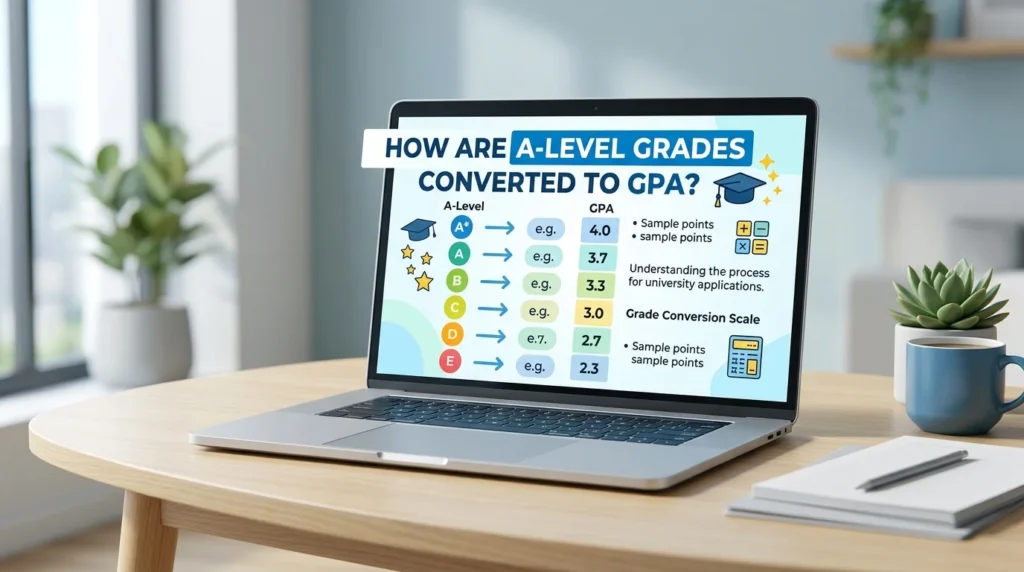
| A Level Grade | GPA (4.0 Scale) | GPA (5.0 Scale) | Quality Points |
|---|---|---|---|
| A* | 4.0 | 5.0 | Excellent |
| A | 4.0 | 4.5 | Excellent |
| B | 3.3 | 4.0 | Good |
| C | 2.7 | 3.5 | Satisfactory |
| D | 2.0 | 2.5 | Pass |
| E | 1.3 | 2.0 | Pass |
| U | 0.0 | 0.0 | Fail |
Note: Some institutions may use slightly different conversion scales. An A Levels to GPA Converter provides an estimate based on commonly accepted standards, but applicants should always verify conversion requirements with their target university.
Student Profile:
Using an A-Levels to GPA Calculator can help estimate how these grades may look on a 4.0 GPA scale.
Calculation (4.0 Scale):
Total Grade Points: 14.0
Total Credits: 4
Estimated GPA: 14.0 ÷ 4 = 3.5
This example shows how A-Level grades can be converted into an estimated GPA for comparison purposes.
Student Profile:
Calculation (4.0 Scale):
Total Grade Points: 14.3
Total Credits: 5.0
Estimated GPA: 14.3 ÷ 5.0 = 2.86
The credit weighting matters because AS Levels are often treated differently from full A-Level qualifications in conversion models.
Using an A-Levels to GPA Calculator can be helpful when you need to compare UK qualifications with grading systems used in other countries.
Many universities use GPA as part of their admission process. An estimated GPA can help you understand how your academic performance may compare with a university’s published requirements.
However, universities may evaluate A-Level qualifications directly rather than requiring students to provide a self-calculated GPA.
Some scholarships have minimum academic requirements. A GPA estimate can help you compare your results with those requirements before applying.
Always check whether the scholarship provider has a specific A-Level conversion policy.
Students moving between educational systems may need to understand how their qualifications compare with another grading structure.
An estimated GPA can provide a useful reference, although the receiving institution makes the final decision about credit and grade equivalency.
Graduate programs may ask for GPA information, particularly when applicants have studied under different education systems. In these cases, applicants should follow the institution’s instructions instead of relying only on an online conversion.
Some employers may request academic results or GPA information. A conversion can provide context when an employer is familiar with the GPA system but not the A-Level grading structure.
US universities commonly use a 4.0 GPA scale, although grading practices can differ between institutions.
When applying to US universities:
There is no universal rule that an A-Level grade must equal one specific US GPA value. Therefore, an A-Levels to GPA Calculator should be viewed as an estimate rather than an official conversion.
Canadian universities use several grading systems.
Depending on the institution or province, you may encounter:
Many Canadian universities recognize A-Level qualifications directly. Check the admission requirements of your chosen institution before converting your grades.
Different countries use different grading structures.
Australia: Universities may use GPA systems alongside other grading methods.
Germany: The German grading scale generally ranges from 1.0 to 6.0, where lower numbers represent stronger performance.
Netherlands: Universities commonly use a 1–10 grading scale.
Because these systems differ, there is no single global A-Level-to-GPA formula.
Use a reputable calculator or an official university conversion guide whenever one is available. Avoid assuming that every institution follows the same formula.
Enter all qualifications that the specific conversion method requires. Depending on the institution, this may include AS Levels, A-Levels, or other academic credentials.
Keep copies of your official certificates and transcripts. These documents may be required during university applications.
Before submitting a converted GPA, contact the admissions office if the university does not clearly explain how it evaluates A-Level qualifications.
If your grades improved during your studies, your academic progression may provide useful context. Some admissions teams consider the overall academic profile rather than focusing on one converted number.
Keep at least two decimal places when performing calculations. This makes your estimate easier to review and reduces unnecessary rounding differences.
If your chosen conversion method treats AS Levels differently from full A-Levels, make sure you apply the correct weighting.
If you are still completing your qualifications, update the calculation when you receive new results. This gives you a more current estimate.
An A-Levels to GPA Calculator provides an estimated comparison, not an official academic equivalency. Universities may use their own evaluation methods, especially for international applicants.
For an application, always follow the instructions provided by the university, scholarship organization, or credential evaluation service.
An A-Levels to GPA Calculator estimates your GPA by converting your A-Level grades into an equivalent GPA based on commonly used conversion methods. It helps students understand how their academic performance may compare with GPA-based systems.
Yes. Many universities accept A-Level qualifications, but some applications may ask for an estimated GPA. An A-Levels to GPA Calculator provides a helpful estimate, although universities may use their own evaluation process.
No. GPA conversion methods vary between universities and countries. Always check the official admission requirements of the institution you are applying to for the most accurate evaluation.
An A Levels to GPA Converter helps students estimate their GPA from A Level grades using commonly accepted conversion methods. This conversion can be useful when applying to universities that use the GPA system for admissions, scholarships, or academic evaluations. By converting your grades accurately, you can better understand your academic standing and prepare stronger university applications.
For another helpful A Levels to GPA conversion resource, you can also visit:
https://smartcgpa.com/a-level-to-gpa-converter
Next, enter your A Level grades into the A Levels to GPA Converter and select the appropriate grading scale. Then click the calculate button to instantly view your estimated GPA, grade equivalents, and academic performance results for university applications.

CGPA to Percentage is a free educational platform that helps students calculate CGPA, GPA, percentages, grades, credit hours, and other academic scores.
© 2026. All rights reserved.