📚 Your Courses
0.00
Your GPA
0
Total Credits
0.00
Total Points
0
Total Courses
Calculate your Grade Point Average with ease
Understanding your GPA Calculator results and your Grade Point Average (GPA) is crucial for academic success, college admissions, and scholarship opportunities. Our GPA Calculator helps high school and college students, study abroad applicants, and academic advisors quickly calculate accurate GPAs using various grading scales and credit hours. Whether you want to estimate your semester GPA or cumulative GPA, a reliable GPA Calculator provides fast, accurate, and hassle-free results.
Grade Point Average (GPA) is a numerical representation of your academic performance calculated by averaging the grade points earned across all courses. Each letter grade corresponds to a specific point value, which is then weighted by the credit hours of each course.
A GPA Calculator simplifies this process by automatically calculating your GPA after you enter your grades and credit hours. GPA serves as a standardized metric that educational institutions use to evaluate student performance, making it easier to compare academic achievements across different schools and programs.
Your GPA plays a critical role in several aspects of your academic and professional journey, and a GPA Calculator helps you monitor it accurately.
Academic standing and graduation requirements depend on maintaining minimum GPA thresholds. Most institutions require students to maintain at least a 2.0 GPA to remain in good standing.
College admissions committees heavily weigh GPA when evaluating applications. Competitive universities often look for GPAs above 3.5, while Ivy League schools typically expect GPAs near 4.0.
Scholarship opportunities frequently have GPA requirements ranging from 3.0 to 3.8 depending on the program. Merit-based financial aid often requires maintaining specific GPA levels throughout your studies.
Graduate school applications, internships, and employers may also consider your GPA as evidence of academic ability and consistency.
Using a GPA Calculator regularly allows students to track their progress, identify areas for improvement, and prepare for future academic opportunities.
A GPA Calculator usually supports multiple grading systems to meet different educational standards.
4.0 Scale
The 4.0 scale is the most common grading system in the United States, where:
A = 4.0
B = 3.0
C = 2.0
D = 1.0
F = 0.0
This unweighted scale treats all courses equally regardless of their difficulty.
5.0 Scale
The 5.0 scale is commonly used for weighted GPAs in high schools that offer Advanced Placement (AP), IB, or Honors courses. Students can earn GPAs above 4.0 because advanced courses receive additional grade points.
10.0 Scale
The 10.0 scale is widely used in India and several other countries. It is commonly associated with CGPA (Cumulative Grade Point Average) systems used by universities and technical institutions.
A quality GPA Calculator can easily switch between these grading systems, making it useful for international students as well.
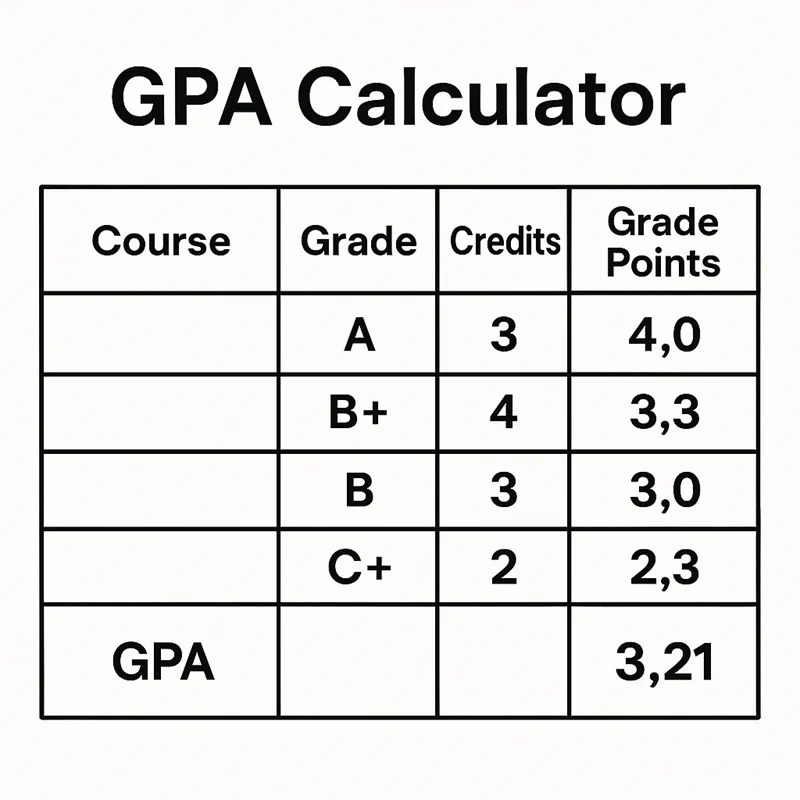
A GPA Calculator automatically performs the calculation using the standard formula:
GPA = Total Grade Points ÷ Total Credit Hours
To calculate grade points for each course:
Convert the letter grade into its numerical value.
Multiply the grade point by the course credit hours.
Add all grade points together.
Divide by the total credit hours attempted.
A GPA Calculator performs these steps instantly, reducing manual errors and saving time.
Suppose a student completes four courses in one semester.
Course 1: Biology (4 credit hours) – Grade: A (4.0)
Grade Points = 4.0 × 4 = 16.0
Course 2: Mathematics (3 credit hours) – Grade: B+ (3.3)
Grade Points = 3.3 × 3 = 9.9
Course 3: English (3 credit hours) – Grade: A− (3.7)
Grade Points = 3.7 × 3 = 11.1
Course 4: History (2 credit hours) – Grade: B (3.0)
Grade Points = 3.0 × 2 = 6.0
Total Grade Points: 43.0
Total Credit Hours: 12
GPA = 43.0 ÷ 12 = 3.58
Instead of calculating manually, entering this information into a GPA Calculator instantly produces the same result.
Credit hours represent the amount of classroom instruction associated with each course. Most subjects carry between one and four credit hours, with laboratory courses and major subjects often carrying additional credits.
A GPA Calculator multiplies each course’s grade points by its credit hours to determine the weighted contribution of every subject. Because higher-credit courses have a greater impact on your GPA, understanding this relationship helps students make smarter academic decisions and manage their course loads effectively.
Unweighted GPA
An unweighted GPA uses the standard 4.0 grading scale without considering course difficulty. Regular, Honors, and AP courses all receive the same point values.
Weighted GPA
A weighted GPA rewards students for taking more challenging classes by assigning additional grade points to Honors, AP, or IB courses. This allows students to earn GPAs above 4.0.
Most universities review both weighted and unweighted GPAs during admissions. A GPA Calculator that supports both methods helps students compare their academic performance under different grading systems and better prepare for college applications.
| Letter Grade | 4.0 Scale | Percentage Range |
| A+ | 4.0 | 97-100% |
| A | 4.0 | 93-96% |
| A- | 3.7 | 90-92% |
| B+ | 3.3 | 87-89% |
| B | 3.0 | 83-86% |
| B- | 2.7 | 80-82% |
| C+ | 2.3 | 77-79% |
| C | 2.0 | 73-76% |
| C- | 1.7 | 70-72% |
| D+ | 1.3 | 67-69% |
| D | 1.0 | 65-66% |
| F | 0.0 | Below 65% |
| Country/System | Scale | 4.0 Equivalent |
|---|---|---|
| India (CGPA) | 10.0 | Multiply by 0.4 |
| UK (First Class) | 70%+ | 3.7–4.0 |
| Germany | 1.0–4.0 | Inverse scale |
| France | 0–20 | Divide by 5 |
| China | 0–100 | Standard percentage |
| IB Program | 1–7 | 7=4.0, 6=3.7, 5=3.0 |

Complement your GPA calculations with additional academic planning tools that help optimize your educational strategy.
Final Grade Calculator helps determine what score you need on upcoming exams or assignments to achieve your target course grade. This tool is invaluable for academic planning and prioritizing study efforts.
Grade Percentage Converter translates between different grading systems, making it easier to understand your performance across various scales and compare international academic records.
Credit Hour Tracker monitors your progress toward graduation requirements, ensuring you’re on track to complete your degree within the expected timeframe while maintaining your desired GPA.
A GPA Calculator is one of the most valuable academic tools for students who want to monitor and improve their performance throughout high school, college, or university. Instead of spending time performing complex manual calculations, a GPA Calculator provides fast, accurate results based on your grades and credit hours. It helps you understand your current academic standing, set realistic GPA goals, and make informed decisions about future courses.
Whether you’re preparing for scholarships, internships, graduation requirements, or university admissions, using a reliable GPA Calculator ensures that your calculations are consistent and error-free. By tracking your GPA regularly, you can identify opportunities for improvement early and stay focused on achieving your academic objectives. A dependable GPA Calculator not only saves time but also gives you greater confidence when planning your educational journey.
Ready to calculate your GPA with confidence?
Start using a trusted GPA Calculator to instantly determine your semester or cumulative GPA based on your grades and credit hours. A quality GPA Calculator makes it simple to monitor your progress, compare different grading scenarios, and estimate the grades you need to reach your academic goals.
For another reliable GPA calculation resource, visit:
https://www.calculator.net/gpa-calculator.html
Using a GPA Calculator regularly can help you stay organized throughout every semester. It allows you to evaluate how individual course grades affect your overall GPA, prepare for scholarship applications, and understand graduation requirements before they become a concern. Many students also use a GPA Calculator to test different grade scenarios before final exams, making it easier to prioritize study time and improve academic performance. Whether you’re a first-year student or nearing graduation, a dependable GPA Calculator can become an essential part of your academic planning toolkit, helping you make smarter decisions and stay on track toward long-term success.

CGPA to Percentage is a free educational platform that helps students calculate CGPA, GPA, percentages, grades, credit hours, and other academic scores.
© 2026. All rights reserved.