Calculate incline percentage and slope angle from rise and run measurements. Perfect for runners, cyclists, hikers, and engineers.
Grade (%) = (Rise ÷ Run) × 100
Angle (°) = arctan(Rise ÷ Run) × (180 ÷ π)
A Hill Grade Calculator helps determine the steepness of any inclined surface by measuring the vertical rise against the horizontal distance. Whether you’re planning a cycling route, designing a road, constructing a driveway, evaluating hiking trails, or setting up a treadmill workout, a Hill Grade Calculator provides fast and accurate slope calculations. Understanding hill grade is essential for safety, engineering accuracy, and performance analysis across many industries.
A Hill Grade Calculator is commonly used in construction, transportation planning, civil engineering, fitness training, surveying, and outdoor recreation. Instead of performing complex manual calculations, you can use a Hill Grade Calculator to instantly determine the slope percentage, making planning easier and more reliable.
The Hill Grade Calculator uses a simple mathematical formula:
Grade (%) = (Rise ÷ Run) × 100
This formula measures the relationship between the vertical elevation change and the horizontal distance traveled.
Rise represents the vertical distance or elevation change between two points. It measures how much higher or lower one point is compared to another.
For example:
A hill that climbs 20 meters has a rise of 20 meters.
A driveway that increases 3 feet in elevation has a rise of 3 feet.
When using a Hill Grade Calculator, entering an accurate rise value is essential for obtaining reliable results.
Run represents the horizontal distance between the same two points. Unlike the rise, the run measures the flat ground distance rather than the actual length of the slope.
Examples include:
A hiking trail extending 200 meters horizontally.
A road covering 500 feet before reaching the top of a hill.
A wheelchair ramp extending 30 feet along the ground.
A Hill Grade Calculator combines both rise and run values to calculate the slope percentage automatically.
Suppose you have:
Rise = 15 meters
Run = 150 meters
Using the formula:
Grade = (15 ÷ 150) × 100
Grade = 10%
This means the hill rises 10 meters for every 100 meters of horizontal distance. A Hill Grade Calculator performs this calculation instantly without requiring manual math.
A Hill Grade Calculator saves time while providing highly accurate slope measurements. It eliminates human calculation errors and helps users make informed decisions before beginning a project or activity.
Professionals and individuals use a Hill Grade Calculator for many reasons:
Designing roads and highways.
Planning residential driveways.
Calculating wheelchair ramp gradients.
Building drainage systems.
Estimating earthwork requirements.
Measuring hiking trail difficulty.
Planning cycling and running routes.
Setting treadmill incline workouts.
Surveying land elevations.
Evaluating construction site slopes.
Engineers use a Hill Grade Calculator to verify that roads, driveways, parking lots, and sidewalks comply with local building codes. Proper slope calculations also improve drainage and reduce erosion problems.
Road designers rely on a Hill Grade Calculator to ensure highways and streets remain safe for vehicles. Excessively steep grades can affect braking distance, fuel consumption, and overall traffic safety.
Cyclists often use a Hill Grade Calculator to compare route difficulty and estimate climbing effort. Runners also calculate hill grades to improve training intensity and monitor performance during hill workouts.
Hikers use a Hill Grade Calculator to understand trail steepness before starting a hike. Knowing the grade helps estimate hiking difficulty, required fitness level, and expected travel time.
Many treadmills display incline as a percentage. A Hill Grade Calculator allows users to convert real-world hill gradients into treadmill settings for more realistic indoor training sessions.
Using a Hill Grade Calculator offers several advantages:
Produces accurate slope percentage calculations.
Eliminates manual calculation mistakes.
Saves valuable planning time.
Supports safer construction and engineering projects.
Helps estimate terrain difficulty before outdoor activities.
Improves road and drainage design.
Assists with accessibility compliance for ramps and pathways.
Makes project planning more efficient for professionals and homeowners.
Whether you’re an engineer, contractor, architect, cyclist, runner, surveyor, fitness enthusiast, or homeowner, a Hill Grade Calculator provides reliable slope calculations that support better planning and decision-making. By understanding hill grade and using a Hill Grade Calculator regularly, you can confidently evaluate elevation changes, improve project accuracy, and ensure safer, more efficient outcomes for construction, transportation, recreation, and fitness applications.
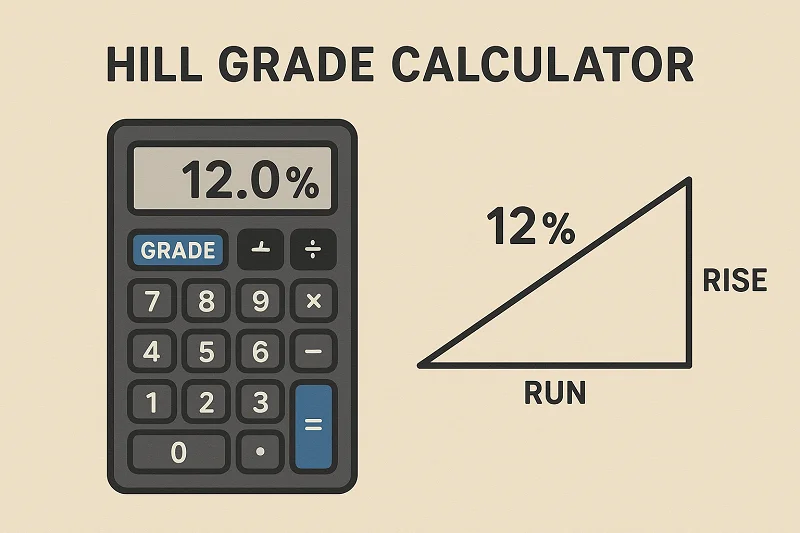
Hill grade is the measurement of how steep an inclined surface is, expressed as a percentage. It tells you how much the elevation changes for every 100 units of horizontal distance.
A road incline of 5% means the road rises 5 feet for every 100 feet of horizontal distance. This grade percentage system is standard in engineering, construction, and transportation industries.
Common applications include road construction, railway design, cycling route planning, treadmill settings, and vehicle performance testing.
Here’s a simple example to calculate hill slope:
A hill rises 15 feet over a horizontal distance of 300 feet.
Grade (%) = (15 ÷ 300) × 100 = 5%
This means the hill incline is 5%, which is considered a moderate slope suitable for most vehicles and cyclists.
For a steeper example: if a hill rises 25 feet over 100 feet of horizontal distance, the grade would be 25% – a very steep incline that challenges both vehicles and pedestrians.
A Hill Grade Calculator is an essential tool for anyone who needs to measure slope accurately and make informed decisions based on elevation changes. Whether you’re planning a construction project, designing a driveway, evaluating hiking trails, or working on road engineering, a Hill Grade Calculator provides quick and reliable calculations that eliminate the guesswork.
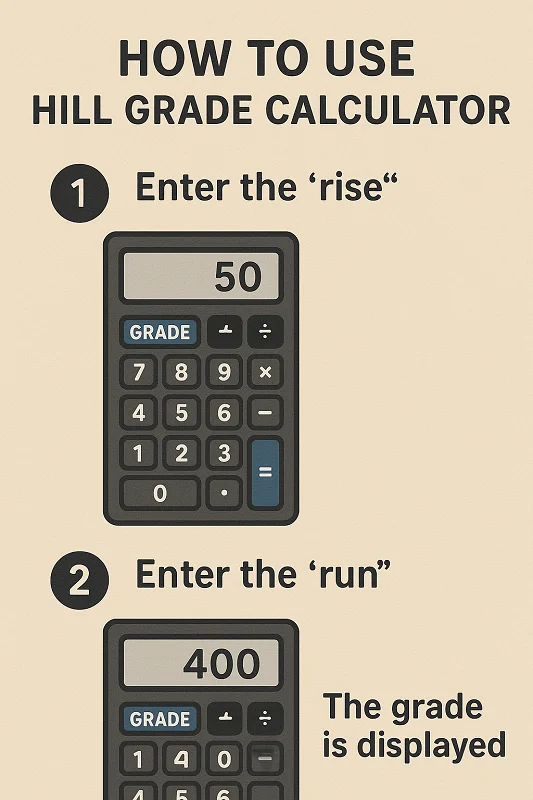
Instead of performing manual calculations that can be time-consuming and prone to errors, you can simply enter the rise and run values to determine the grade percentage instantly. This saves valuable time while improving accuracy for both professionals and everyday users.
Using a Hill Grade Calculator regularly also helps you compare different slope angles, assess terrain difficulty, and ensure your projects meet local safety standards and engineering guidelines. From homeowners planning landscaping projects to civil engineers designing highways, understanding hill grade is an important part of creating safe, efficient, and functional designs.
As your projects become more complex, consistently using a Hill Grade Calculator allows you to make better planning decisions, estimate material requirements more accurately, improve drainage design, and reduce the likelihood of costly mistakes. Whether the slope is gentle or steep, having precise grade calculations gives you greater confidence throughout every stage of your project.
Ready to calculate slope and elevation with confidence?
Use a trusted Hill Grade Calculator to instantly determine the grade percentage of any hill, road, trail, driveway, or construction site. Simply enter the vertical rise and horizontal distance to receive fast, accurate results that help you plan your project more effectively.
For an additional Hill Grade Calculator resource, visit:
https://www.omnicalculator.com/construction/elevation-grade
A reliable Hill Grade Calculator can help homeowners, contractors, architects, engineers, surveyors, cyclists, runners, hikers, and landscape designers evaluate terrain with greater precision. Whether you’re checking if a driveway meets local building codes, calculating the steepness of a hiking route, designing proper drainage for a property, or estimating earthwork for a construction project, accurate slope measurements are essential.
Using a Hill Grade Calculator before beginning any project helps improve planning, supports better budgeting, and reduces the risk of design errors caused by incorrect elevation estimates. It also allows you to compare multiple slope options, identify potential accessibility concerns, and verify whether your plans comply with recommended engineering or construction standards.
Make a Hill Grade Calculator part of your regular planning process whenever you work with elevation changes. By calculating hill grades accurately from the start, you’ll save time, improve project quality, minimize costly revisions, and make more informed decisions for residential, commercial, recreational, or infrastructure projects.

CGPA to Percentage is a free educational platform that helps students calculate CGPA, GPA, percentages, grades, credit hours, and other academic scores.
© 2026. All rights reserved.