Managing your GPA in college requires more than just earning good grades—it demands strategic thinking about credit hours, course selection, and timing. A Credit Hour GPA Rebalancer is your secret weapon for making informed academic decisions that can significantly impact your overall GPA.
Whether you’re trying to raise your GPA for graduation honors, meet scholarship requirements, improve your academic standing, or prepare for graduate school applications, a Credit Hour GPA Rebalancer helps you understand how credit hours influence your GPA and supports smarter academic planning.
A Credit Hour GPA Rebalancer is a specialized tool that helps students calculate, analyze, and plan their GPA by considering the weight of credit hours in different courses. Unlike simple GPA calculators that treat all courses equally, a Credit Hour GPA Rebalancer recognizes that a 4-credit course has four times more impact on your cumulative GPA than a 1-credit course.
The Credit Hour GPA Rebalancer allows students to evaluate different academic scenarios before selecting courses or estimating semester results. By understanding the effect of each course, students can make more informed decisions and improve their long-term academic performance.
This tool serves multiple purposes for students:
Strategic Course Planning: Identify which courses will have the greatest impact on your GPA.
Academic Recovery: Plan how to recover from lower grades by performing well in higher-credit courses.
Goal Setting: Determine the grades required in upcoming courses to achieve your target GPA.
Risk Assessment: Understand how poor performance in high-credit courses can affect your cumulative GPA.
Academic Planning: Compare multiple grade scenarios before registration or final examinations.
The importance of a Credit Hour GPA Rebalancer becomes clear when you realize that your GPA is not simply an average of your grades. Instead, it is a weighted average where credit hours determine how much each course contributes to your final GPA.
Understanding the relationship between credit hours and GPA is fundamental to academic success. Most students know that GPA stands for Grade Point Average, but many do not fully understand how credit hours increase or reduce the impact of individual grades.
In a traditional GPA calculation, each course grade is multiplied by its credit hours to produce grade points. These grade points are then divided by the total credit hours attempted to determine your GPA. A Credit Hour GPA Rebalancer performs this calculation automatically and helps you visualize how every course contributes to your cumulative GPA.
This means that a poor grade in a high-credit course can significantly reduce your GPA, while an excellent grade in that same course can substantially improve it.
Consider this example:
Sarah earns an A (4.0) in a 1-credit seminar and a C (2.0) in a 4-credit statistics course.
Her GPA is not simply 3.0, because credit hours are weighted.
Seminar: 4.0 × 1 credit = 4.0 grade points
Statistics: 2.0 × 4 credits = 8.0 grade points
Total: 12.0 grade points ÷ 5 total credits = 2.4 GPA
This example demonstrates why using a Credit Hour GPA Rebalancer is valuable. The 4-credit course carries much more weight than the 1-credit course, so it has a greater influence on the final GPA.
Calculating your weighted GPA manually helps you understand exactly how every course affects your academic performance. While a Credit Hour GPA Rebalancer completes these calculations instantly, learning the formula helps you verify the results.
GPA = Total Grade Points ÷ Total Credit Hours
Where:
Grade Points = Grade Value × Credit Hours
Use your institution’s grading scale.
For a standard 4.0 scale:
A = 4.0
B = 3.0
C = 2.0
D = 1.0
F = 0.0
If your university uses plus and minus grades:
A− = 3.7
B+ = 3.3
B− = 2.7
C+ = 2.3
| Course | Grade | Grade Value | Credit Hours | Grade Points |
|---|---|---|---|---|
| Biology | A | 4.0 | 4 | 16.0 |
| English | B+ | 3.3 | 3 | 9.9 |
| Mathematics | C | 2.0 | 4 | 8.0 |
| History | A− | 3.7 | 3 | 11.1 |
| Total | — | — | 14 | 45.0 |
GPA = 45.0 ÷ 14 = 3.21
Although manual calculations improve your understanding, a Credit Hour GPA Rebalancer saves time and minimizes calculation errors. It also allows you to test different grade combinations, compare future GPA outcomes, and determine how much improvement is possible before the semester ends.
Many students use a Credit Hour GPA Rebalancer before course registration, scholarship applications, or graduation planning because it provides a clear picture of how future grades and credit hours will influence their cumulative GPA. Regularly using a Credit Hour GPA Rebalancer helps students make smarter academic decisions, prioritize high-credit courses, and stay on track toward achieving their desired GPA goals.
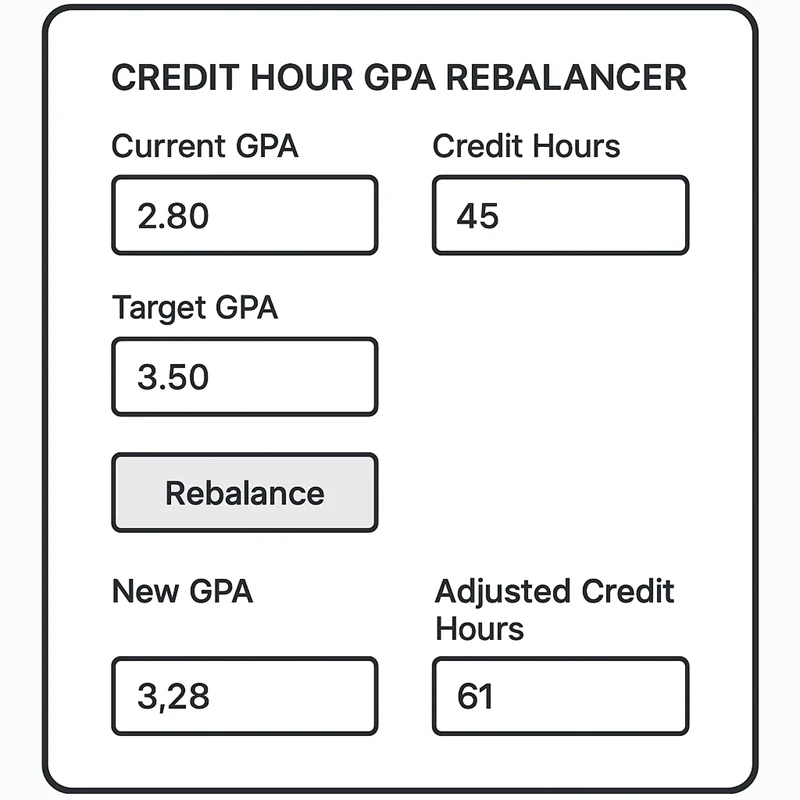
Using a Credit Hour GPA Rebalancer streamlines this process and provides additional planning capabilities. Here’s how to use most GPA rebalancer tools effectively:
Step 1: Input your current academic record
Step 2: Set your GPA goals
Step 3: Plan future courses
Step 4: Analyze the results
Most GPA rebalancer tools also provide visual representations of your GPA trends, making it easier to understand the long-term impact of your academic decisions.
Marcus has a 2.8 GPA with 45 completed credit hours and wants to improve his academic standing. He’s enrolled in a 4-credit organic chemistry course and wonders how much an A would help his GPA.
Current Status:
With 4-Credit A:
This single A would raise Marcus’s GPA by 0.10 points, demonstrating the power of high-credit courses in GPA improvement.
Jennifer earned a D (1.0) in a 1-credit physical education course but maintains strong performance in her major courses. Her current GPA is 3.6 with 60 credit hours.
Impact Analysis:
This scenario shows how low-credit courses, while still important, have limited impact on overall GPA compared to major courses.
Alex needs a 3.5 GPA to graduate magna cum laude but currently has a 3.4 GPA with 90 credit hours completed. He has 30 credit hours remaining and wants to know what GPA he needs in his final courses.
Calculation:
Alex needs to maintain a 3.8 GPA in his remaining 30 credit hours to achieve his goal. This information helps him prioritize his studies and make informed decisions about course selection and study time allocation.
Your high-credit courses deserve the most attention because they have the greatest impact on your GPA. A single point difference in a 4-credit course affects your GPA four times more than the same difference in a 1-credit course.
Prioritize your study time accordingly:
Elective courses provide strategic opportunities for GPA improvement. When choosing electives, consider both your interests and their potential GPA impact.
Look for electives that:
Avoid the temptation to choose electives solely based on perceived ease. Courses that seem easy often have hidden challenges, and your GPA benefits more from courses where you can genuinely excel.
While it’s tempting to take many courses simultaneously to graduate faster, overloading can backfire if it leads to lower grades across all courses. Quality often trumps quantity in GPA management.
Consider these factors when planning your course load:
A strategic approach might involve taking fewer courses per semester while maintaining higher grades, especially in high-credit courses.
Many schools allow students to retake courses, with policies varying on how retakes affect GPA. Understanding your school’s retake policy is crucial for strategic GPA planning.
Common retake policies include:
When considering retakes, prioritize high-credit courses where you earned low grades. Retaking a 4-credit course where you earned a D and achieving a B provides much more GPA benefit than retaking a 1-credit course with the same grade improvement.
Different universities have varying policies regarding credit hours and GPA calculations. Understanding your institution’s specific policies is essential for effective GPA planning.
Common Policy Variations:
Research Your School’s Policies:
Some institutions also have specific policies for different types of courses, such as pass/fail options, internships, or study abroad programs. These policies can significantly impact your GPA strategy.
A Credit Hour GPA Rebalancer is an effective tool for students who want to understand how credit hours influence their overall GPA. By adjusting course credits and projected grades, a Credit Hour GPA Rebalancer helps you estimate future GPA outcomes, identify improvement opportunities, and create a realistic academic strategy. Whether you are preparing for graduation, applying for scholarships, or aiming to meet university GPA requirements, using a Credit Hour GPA Rebalancer makes academic planning easier and more accurate.
Instead of relying on manual calculations, a Credit Hour GPA Rebalancer provides quick and reliable estimates, allowing you to see how each course contributes to your cumulative GPA. Regularly reviewing your GPA with this tool can help you make informed decisions about course selection, credit allocation, and study priorities. Ultimately, a Credit Hour GPA Rebalancer gives you greater confidence in managing your academic progress and achieving your long-term educational goals.
Ready to optimize your GPA and see how different credit hours affect your academic performance?
Use a Credit Hour GPA Rebalancer along with the Credit Hours GPA Calculator to calculate your GPA accurately and explore different grade scenarios before your semester ends.
Visit: https://gpacal.com/calculators/credit-hours-gpa-calculator
The calculator is free, easy to use, and designed to help students understand the relationship between grades, credit hours, and cumulative GPA. By combining the insights from a Credit Hour GPA Rebalancer with a reliable GPA calculator, you can make smarter academic decisions, set realistic GPA targets, and stay on track toward graduation and future career opportunities.
ol for any student serious about academic success. By understanding how credit hours weight your grades and using strategic planning, you can make informed decisions that significantly impact your GPA.
Remember that GPA improvement is a long-term process that requires consistent effort and strategic thinking. Use the GPA rebalancer tool regularly to stay on track with your goals, but don’t forget that the tool is only as good as the effort you put into your studies.
The strategies outlined in this guide focusing on high-credit courses, using electives wisely, avoiding overload, and considering strategic retakes can help you optimize your academic performance. However, every student’s situation is unique, and what works for one person may not work for another.
Always consult with your academic advisor to ensure your GPA strategy aligns with your school’s policies and your long-term academic and career goals. Your advisor can provide personalized guidance based on your specific circumstances, major requirements, and institutional policies.
Take control of your academic future today. Use a Credit Hour GPA Rebalancer to understand your current position, set realistic goals, and create a strategic plan for achieving the GPA you need for graduation, honors, scholarships, or graduate school admission.
Your GPA is more than just a number—it’s a reflection of your strategic thinking, planning ability, and commitment to academic excellence. Make it count.

CGPA to Percentage is a free educational platform that helps students calculate CGPA, GPA, percentages, grades, credit hours, and other academic scores.
© 2026. All rights reserved.