A weighted GPA calculator helps high school students accurately calculate their grade point average by accounting for the difficulty level of their courses. This essential tool considers honors, AP, and IB classes that carry additional weight, giving you a true picture of your academic performance and helping you understand how advanced courses can boost your GPA on the 5.0 scale.
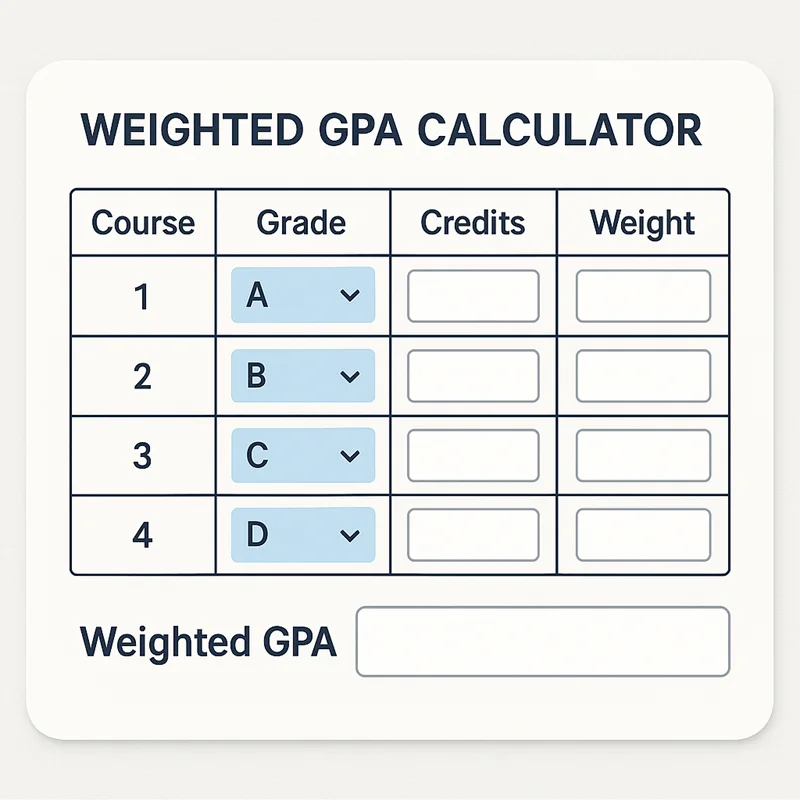
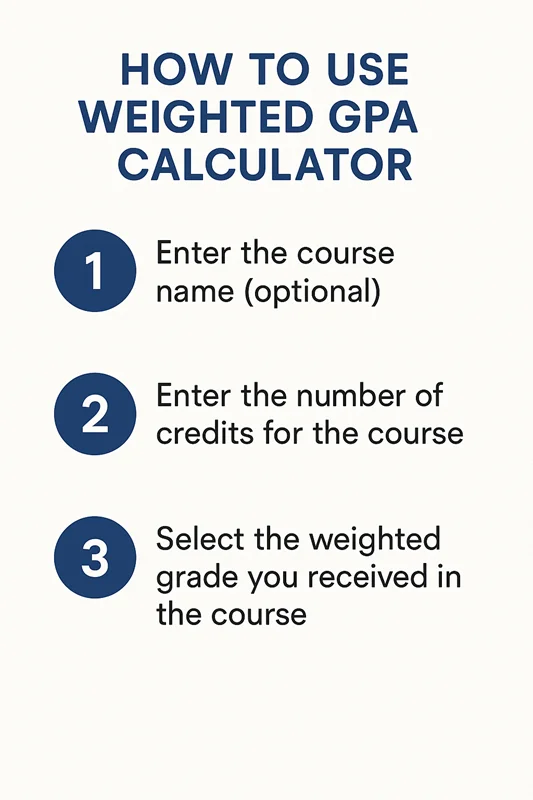
Follow these simple steps to calculate your weighted GPA:
A weighted GPA is a grade point average calculation that gives extra points to grades earned in more challenging courses. Unlike an unweighted GPA that treats all classes equally on a 4.0 scale, weighted GPAs can extend beyond 4.0 when students excel in honors, AP, or IB courses.
The weighted vs unweighted GPA difference is significant for college admissions. While unweighted GPAs max out at 4.0, weighted GPAs can reach 5.0 or higher, reflecting the additional rigor of advanced coursework. This honors GPA scale system rewards students who challenge themselves with difficult classes, even if they don’t earn perfect grades.
When using a GPA calculator for AP classes, students typically see a GPA boost from honors courses because these classes add 0.5 to 1.0 extra points to their grade value, depending on the school’s weighting system.
| Letter Grade | Regular Classes (4.0 Scale) | Honors Classes (4.5 Scale) | AP/IB Classes (5.0 Scale) |
|---|---|---|---|
| A+ | 4.0 | 4.5 | 5.0 |
| A | 4.0 | 4.5 | 5.0 |
| A- | 3.7 | 4.2 | 4.7 |
| B+ | 3.3 | 3.8 | 4.3 |
| B | 3.0 | 3.5 | 4.0 |
| B- | 2.7 | 3.2 | 3.7 |
| C+ | 2.3 | 2.8 | 3.3 |
| C | 2.0 | 2.5 | 3.0 |
| C- | 1.7 | 2.2 | 2.7 |
| D+ | 1.3 | 1.8 | 2.3 |
| D | 1.0 | 1.5 | 2.0 |
| F | 0.0 | 0.0 | 0.0 |
Let’s calculate a weighted GPA using this high school GPA calculation tool example:
Student’s Courses:
Calculation:
This GPA chart for advanced courses shows how taking AP classes significantly boosted this student’s GPA compared to taking all regular courses.
| Aspect | Weighted GPA | Unweighted GPA |
|---|---|---|
| Scale Range | 0.0 to 5.0+ | 0.0 to 4.0 |
| Course Difficulty | Accounts for honors, AP, IB | Treats all courses equally |
| College Admissions | Shows academic rigor | Shows raw academic performance |
| Class Rank | Often used for valedictorian | May be used alongside weighted |
| Transcript Display | Usually appears with unweighted | Standard on all transcripts |
Both GPAs typically appear on high school transcripts because colleges want to see both your raw academic performance (unweighted) and your willingness to take challenging courses (weighted). The 5.0 GPA scale explained above demonstrates why many students pursue advanced courses despite their increased difficulty.
A Weighted GPA Calculator helps students calculate their GPA by considering course difficulty and credit weight. Unlike an unweighted GPA, it gives additional value to honors, AP, IB, or advanced courses, making it a more accurate reflection of academic performance.
| Feature | Weighted GPA | Unweighted GPA |
|---|---|---|
| GPA Scale | Usually 5.0 or 6.0 | 4.0 |
| Course Difficulty Included | ✅ Yes | ❌ No |
| Honors/AP/IB Bonus | ✅ Yes | ❌ No |
| College Admissions | Frequently Used | Also Accepted |
| Reflects Academic Rigor | ✅ Yes | Limited |
| Letter Grade | Standard GPA | Weighted GPA (Honors/AP) |
|---|---|---|
| A | 4.0 | 5.0 |
| A− | 3.7 | 4.7 |
| B+ | 3.3 | 4.3 |
| B | 3.0 | 4.0 |
| C+ | 2.3 | 3.3 |
| C | 2.0 | 3.0 |
| D | 1.0 | 2.0 |
| F | 0.0 | 0.0 |
| Course | Credits | Grade | Weighted Grade Points |
|---|---|---|---|
| AP Mathematics | 4 | A | 5.0 |
| Honors Chemistry | 4 | B+ | 4.3 |
| English | 3 | A− | 3.7 |
| Physics | 4 | B | 3.0 |
| History | 3 | A | 4.0 |
Weighted GPA = Total (Grade Points × Credits) ÷ Total Credits
A Weighted GPA Calculator performs this calculation automatically, reducing errors and saving time.
| Benefit | Description |
|---|---|
| Accurate Results | Calculates GPA using weighted grade points and credits. |
| Saves Time | Eliminates manual calculations. |
| Supports Advanced Courses | Includes AP, Honors, and IB courses. |
| College Planning | Helps students monitor academic progress. |
| Easy Comparison | Compare weighted and unweighted GPA easily. |
| Student Type | Recommended |
|---|---|
| High School Students | ✅ |
| AP Students | ✅ |
| IB Students | ✅ |
| Honors Students | ✅ |
| College Applicants | ✅ |
| Scholarship Applicants | ✅ |
Track your GPA regularly using a weighted GPA calculator to stay informed about your academic progress. Calculate your GPA after each semester to identify trends and make informed decisions about future course selections.
Consider using this high school GPA calculation tool before registration periods to see how different course combinations might affect your overall GPA. Remember that taking advanced courses responsibly is key – it’s better to excel in a moderate number of challenging courses than to struggle with an overwhelming course load.
Most importantly, while GPA is important for college admissions, it’s just one factor. Focus on learning, developing your interests, and building a well-rounded application that showcases your unique strengths and experiences.

CGPA to Percentage is a free educational platform that helps students calculate CGPA, GPA, percentages, grades, credit hours, and other academic scores.
© 2026. All rights reserved.