Mercer GPA Calculation Formula
The Mercer GPA calculation follows a standard formula used by most universities:
GPA = Total Grade Points ÷ Total Credit Hours
Here’s a practical example to demonstrate how to calculate Mercer GPA:
Sample Calculation:
- Course 1: Biology (4 credit hours, Grade A = 4.0 points)
- Course 2: English (3 credit hours, Grade B = 3.0 points)
- Course 3: Mathematics (3 credit hours, Grade A = 4.0 points)
Step 1: Calculate grade points for each course
- Biology: 4 credit hours × 4.0 points = 16.0 grade points
- English: 3 credit hours × 3.0 points = 9.0 grade points
- Mathematics: 3 credit hours × 4.0 points = 12.0 grade points
Step 2: Sum the totals
- Total grade points: 16.0 + 9.0 + 12.0 = 37.0
- Total credit hours: 4 + 3 + 3 = 10
Step 3: Apply the formula
The impact of credit hours and grade points cannot be overstated. Courses with higher credit hours carry more weight in your GPA calculation, meaning a poor grade in a 4-credit course will affect your GPA more significantly than the same grade in a 1-credit course.
Mercer Grade Conversion Scale
The Mercer grade conversion scale translates letter grades into numerical grade points:
Letter Grade | Grade Points | Percentage Range |
A | 4.0 | 90-100% |
A- | 3.7 | 87-89% |
B+ | 3.3 | 83-86% |
B | 3.0 | 80-82% |
B- | 2.7 | 77-79% |
C+ | 2.3 | 73-76% |
C | 2.0 | 70-72% |
C- | 1.7 | 67-69% |
D+ | 1.3 | 63-66% |
D | 1.0 | 60-62% |
F | 0.0 | Below 60% |
Honors, AP, and advanced courses may receive additional weight in some high school GPA calculations, but at the university level, Mercer typically uses the standard 4.0 scale. However, students should consult with their academic advisor to understand how any transfer credits from weighted high school courses might be evaluated.
Why Use a Mercer University Points-Based Grade Calculator?
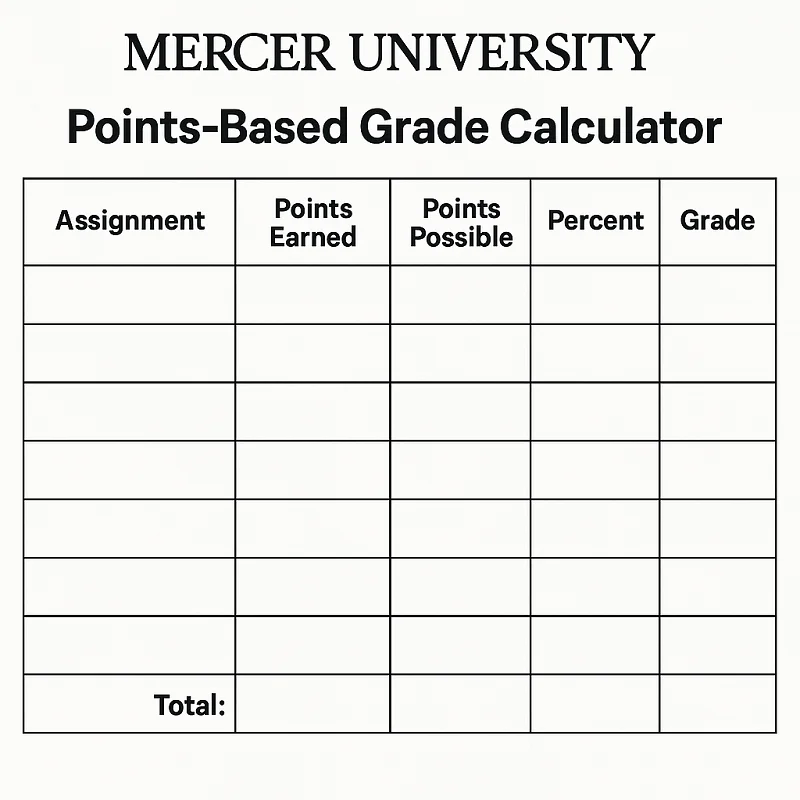
A Mercer University Points-Based Grade Calculator helps students estimate their final course grade based on points earned in assignments, quizzes, exams, and other graded activities. It provides quick and accurate calculations to help students monitor their academic progress.
Sample Points-Based Grading Scale
| Percentage | Letter Grade | Grade Point |
|---|
| 90–100% | A | 4.0 |
| 80–89% | B | 3.0 |
| 70–79% | C | 2.0 |
| 60–69% | D | 1.0 |
| Below 60% | F | 0.0 |
Note: Individual Mercer University courses may use different grading scales. Always refer to your course syllabus.
Points-Based Grade Formula
| Calculation | Formula |
|---|
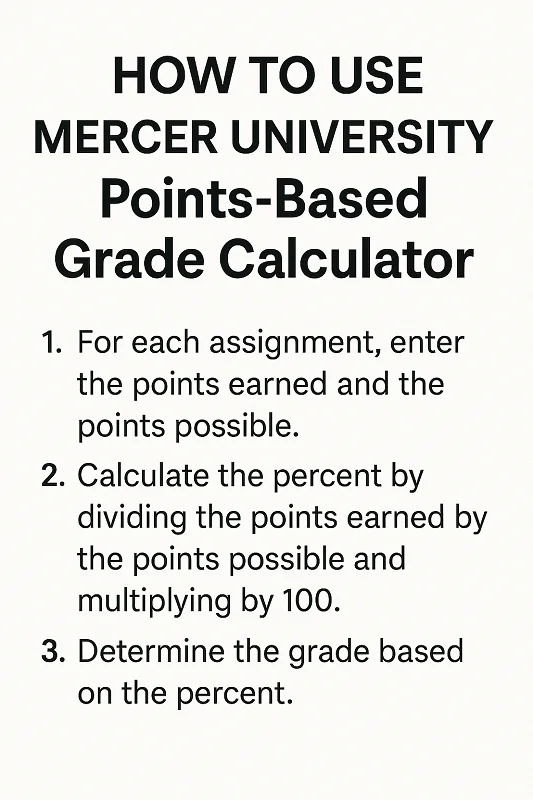
| Percentage Score | (Points Earned ÷ Total Points) × 100 |
| Grade Calculation | Final Grade = Percentage Score |
| Grade Point | Determined using the course grading scale |
A Mercer University Points-Based Grade Calculator automatically calculates your percentage and estimates your final letter grade based on the points entered.
Example Grade Calculation
| Assessment | Points Earned | Total Points |
|---|
| Assignments | 180 | 200 |
| Quizzes | 90 | 100 |
| Midterm Exam | 82 | 100 |
| Final Exam | 170 | 200 |
| Participation | 48 | 50 |
| Total | 570 | 650 |
Final Percentage = (570 ÷ 650) × 100 = 87.69%
Benefits of Using a Mercer University Points-Based Grade Calculator
| Benefit | Description |
|---|
| Instant Results | Calculates grades in seconds. |
| Accurate Calculations | Reduces manual calculation errors. |
| Easy to Use | Enter earned and total points for each assessment. |
| Academic Planning | Helps track performance throughout the semester. |
| Time Saving | Eliminates complex manual calculations. |
When Should You Use a Mercer University Points-Based Grade Calculator?
| Situation | Purpose |
|---|
| Before Final Exams | Estimate the grade you need to achieve your target. |
| During the Semester | Monitor academic performance regularly. |
| Scholarship Applications | Maintain required academic standing. |
| Academic Advising | Review current progress with advisors. |
| End-of-Semester Planning | Estimate your final course grade. |
A Mercer University Points-Based Grade Calculator is a valuable tool for students who want to estimate their final grades accurately, track academic performance, and make informed decisions throughout the semester.